Welcome to a brief insight into a design concept we’ve been working on since last season. Look at it as an evaluation of an idea or a design study. No requirement for production or design protection.
The framing of the question is whether it is possible to create a paddle blade that more effectively solves some of the challenges SUP foiling entails.
The starting point of the project
All paddling with the goal of “taking off” (to start foiling) is done on one side of the board. This is an asymmetrical scenario that provides some interesting possibilities. It means for example that a paddle for SUP-foiling can be optimized to be paddled mainly on one side.
(At the end of this text there is a short summary of the study, if you are in a hurry.)
SUP foiling
The principle of creating speed using a paddle on a SUP foil is similar to most other paddle disciplines. The basic elements are the same: The grip of the blade in the water, the geometry of the paddle stroke in relation to the hull and body, timing etc.
But SUP-foiling also contains some crucial differences that make the discipline unique. The first major difference is that in SUP-foiling you strives to finish paddling as soon as possible, with the goal of switching to foiling mode instead. “To paddle effectively, in order to successfully finish paddling”.
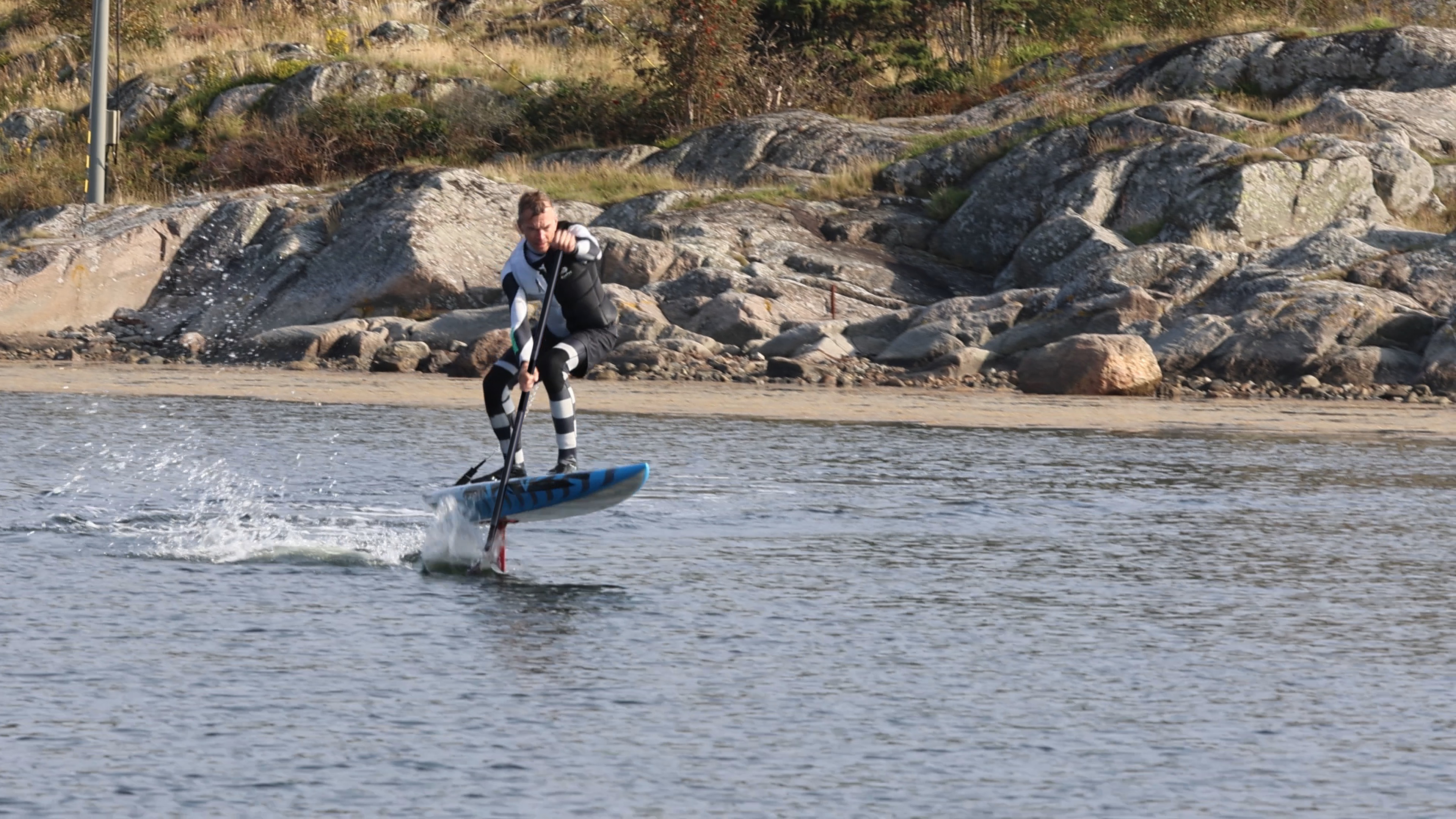
The primary function of the paddling is thus to create sufficient speed to make the hull lift off the surface of the water. And to successfully achieve this, also combine the paddling with a pumping movement of the foil via the board.
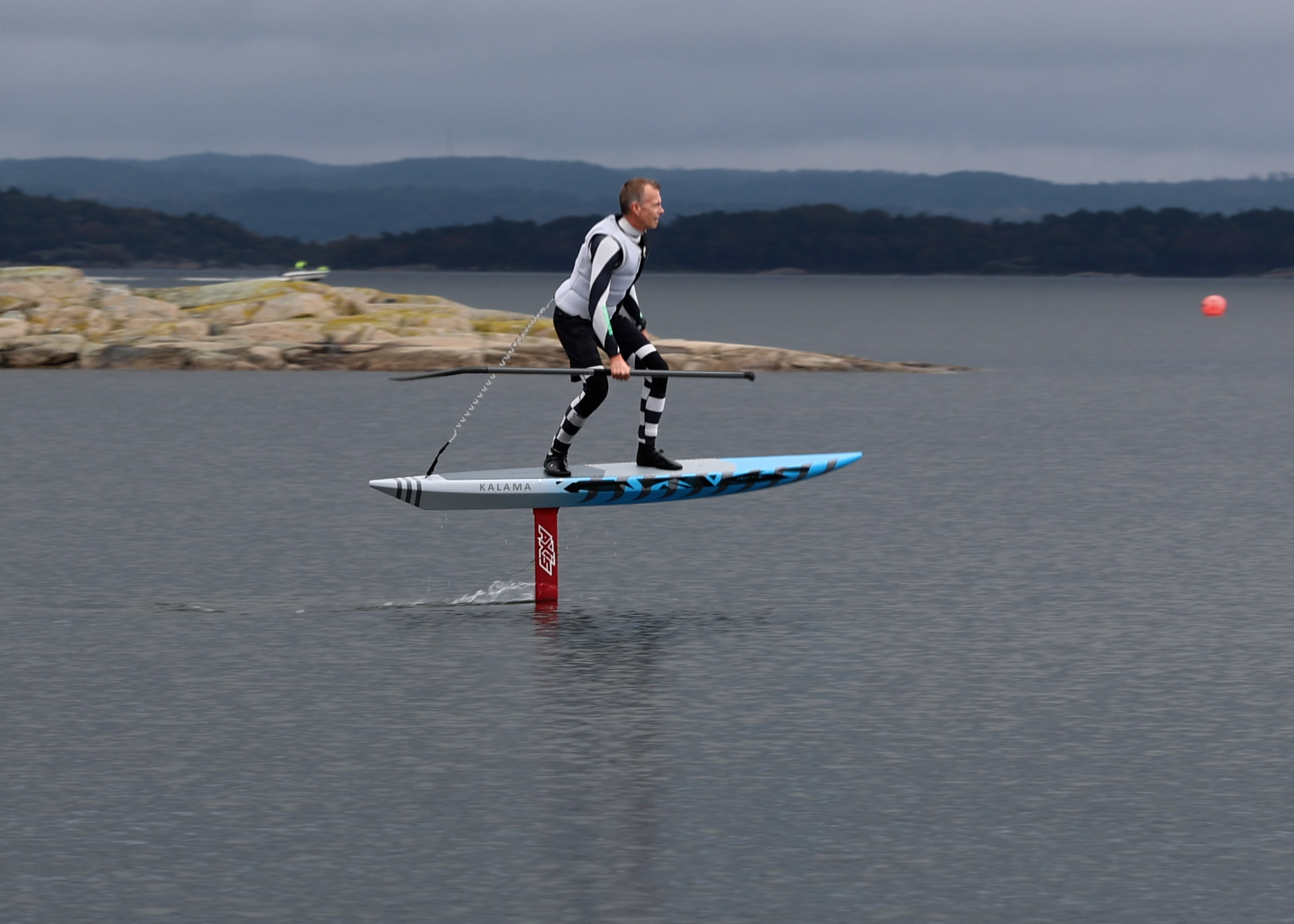
The fact that the effort can be concentrated in fewer than 10 paddle strokes, even on flat water, is nothing unusual. Just 2-3 strokes if you have some swell. Once up on the foil you can completely or partially disconnect the paddle from the propulsion. However, sometimes the paddle needs to be active even during the actual foiling, but rather as support or to give short impulses of paddling force.
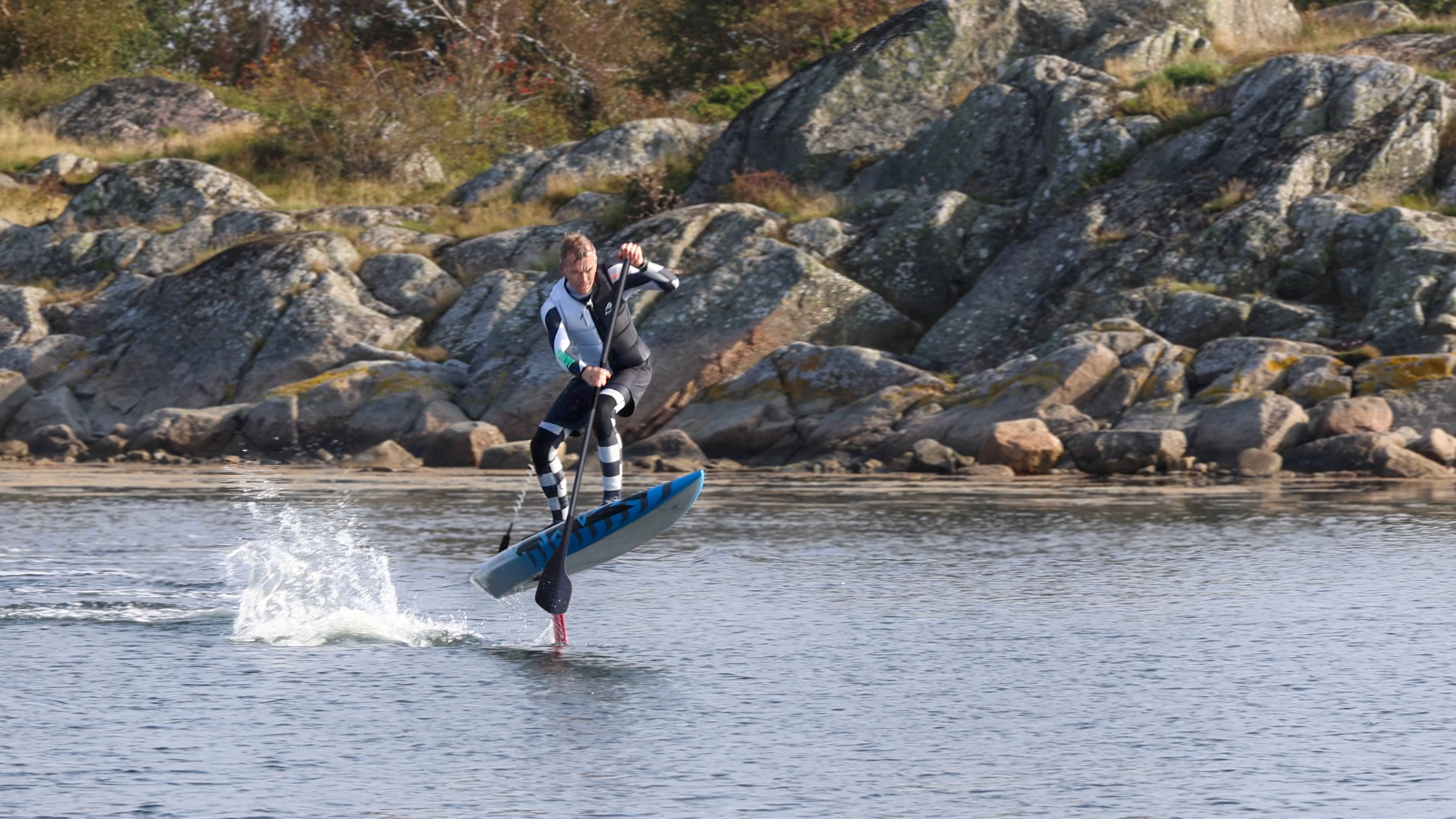
With such a concentrated sequence of a few paddle strokes, the paddling technique is of course crucial for how effective the “paddle ups” to the foil will be. The concept of SUP-foiling is bit similar to a pole vaulter’s requirement to synchronize speed and technique to create lift with the help of a tool. Speed always plays an important role, but without the technique to convert speed into lift, there will be no real height.
Inspiration
Two sources of inspiration form the basis of this design study. Partly our own interest in most things to do with sports and biomechanics. Within that segment there are several ground-breaking innovations. In this case it is about the classic Swedish invention; the wing paddle. Created for kayaking by Stefan Lindeberg together with Leif Håkansson during the mid-80s. (Patent https://patents.google.com/patent/US4737126A/en.) Later the paddle was further developed by Einar Rasmussen from Norway.

The asymmetric shape of the wing paddle, which makes it work best in a non-linear path along the hull, shows how design can “program” a paddle’s path in the water. (Asymmetric shape mainly refers to the cross section of the blade. And by non-linear path along the hull, we mean how the wing blade is designed to travel diagonally out from the hull.)
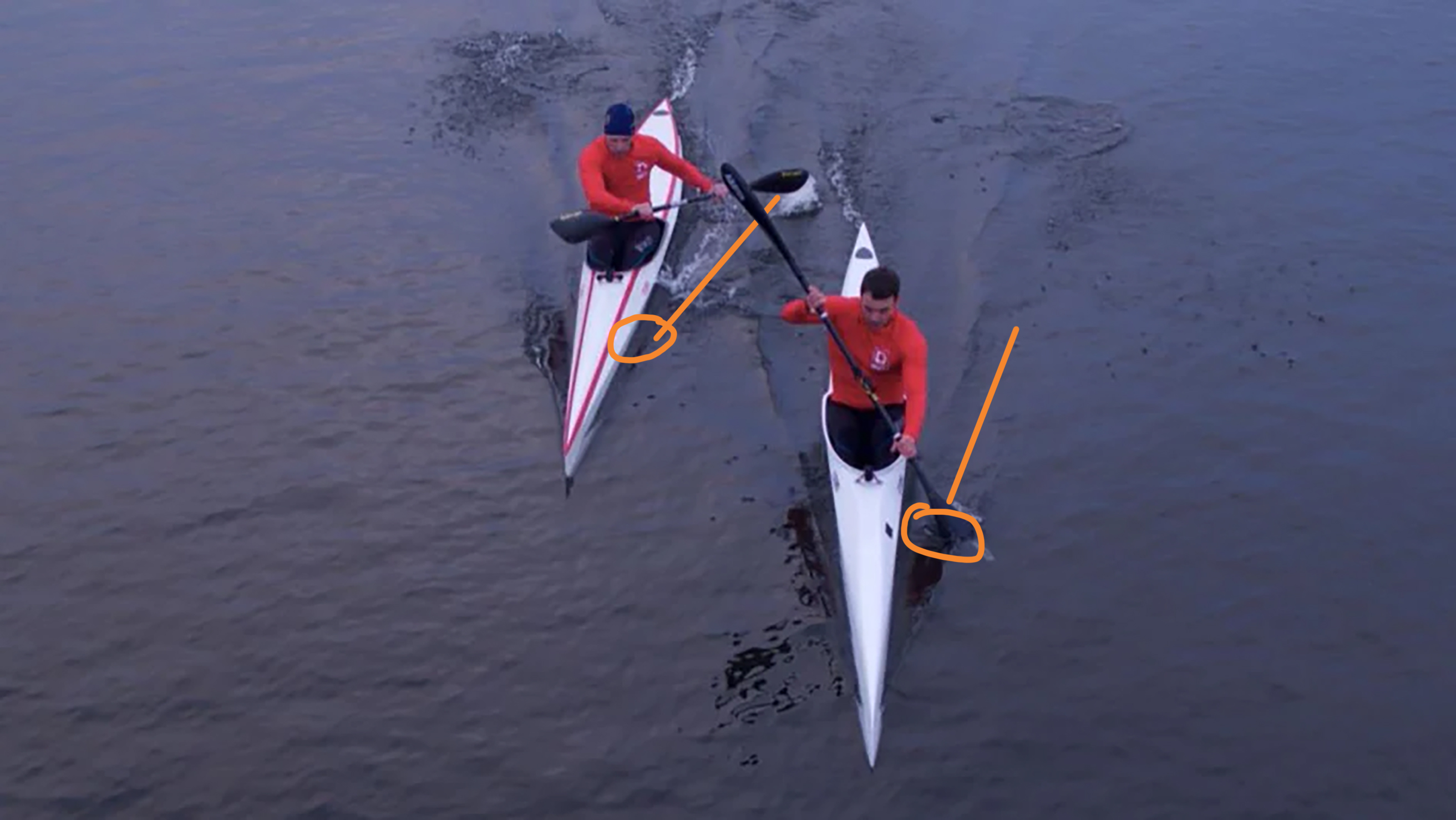
The wing paddle’s path in the water was a result of Stefan Lindeberg and Leif Håkansson’s vision to create a paddle that better matched the new paddling technique that began to enter the competition arenas in the 80s. More rotation of the upper body, with the involvement of larger muscle groups (from the feet and legs, hips, core and all the way up to the shoulders). Less linear backward pull with the arms, resulted in a blade that was optimized to follow the rotating movement of the body. A wing-shaped blade that worked under completely different hydrodynamic principles than the traditional “flat paddles”. 2-4 % is the most commonly stated improvement in speed with the wing paddle. It might not sound much. But if you earn a few meters every hundred meters, that could be the difference between a medal or not.
It’s all about the force and the direction
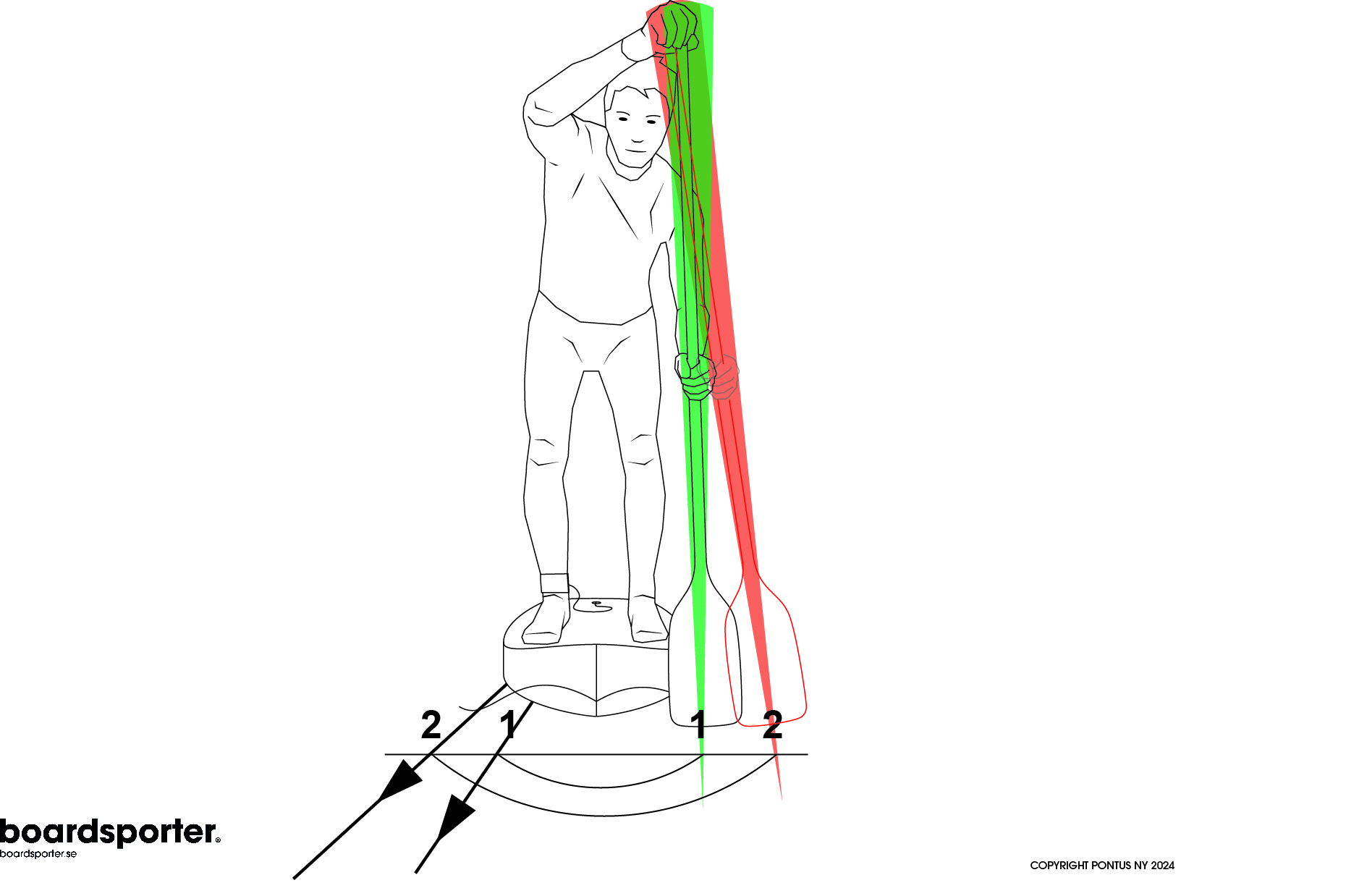
Unlike the wing paddle’s movement outwards from the hull, our SUP foil paddle should instead move diagonally inwards toward the hull. Or rather create a force that is at an angle to the hull and occurs at a certain angle to the direction of travel.
The aim is not to create a wing paddle for SUP-foiling. It is the path of the blade, power development and direction of the energy where we find inspiration from the principles of the wing blade.

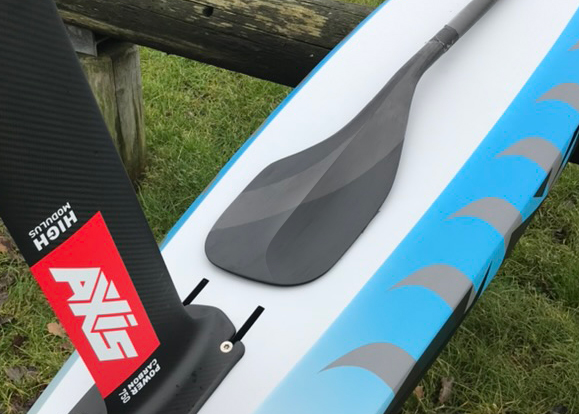
The design principle of what we call the Assypaddle
As just mentioned, our design study does not involve a pure wing shape of the paddle blade. However, we work with an asymmetrical cross-section, in combination with an asymmetrical outline.
The asymmetric cross-section makes one half of the blade slightly offset, which means that the blade more easily takes a non-linear path during the paddle stroke. Starting a bit out from the front of the board, towards the paddler’s body. But still in a straight and powerful path.
This means that the blade more effectively directs a force diagonally forward, which counteracts the board’s yaw / turn. (Newton’s third law: To every action there is always opposed an equal reaction. So, the force that the blade pushes against the water at a backward direction is equal to the force that the water in return pushes against the blade at your forward propulsion. Actioni contrariam semper et æqualem esse reactionem.)
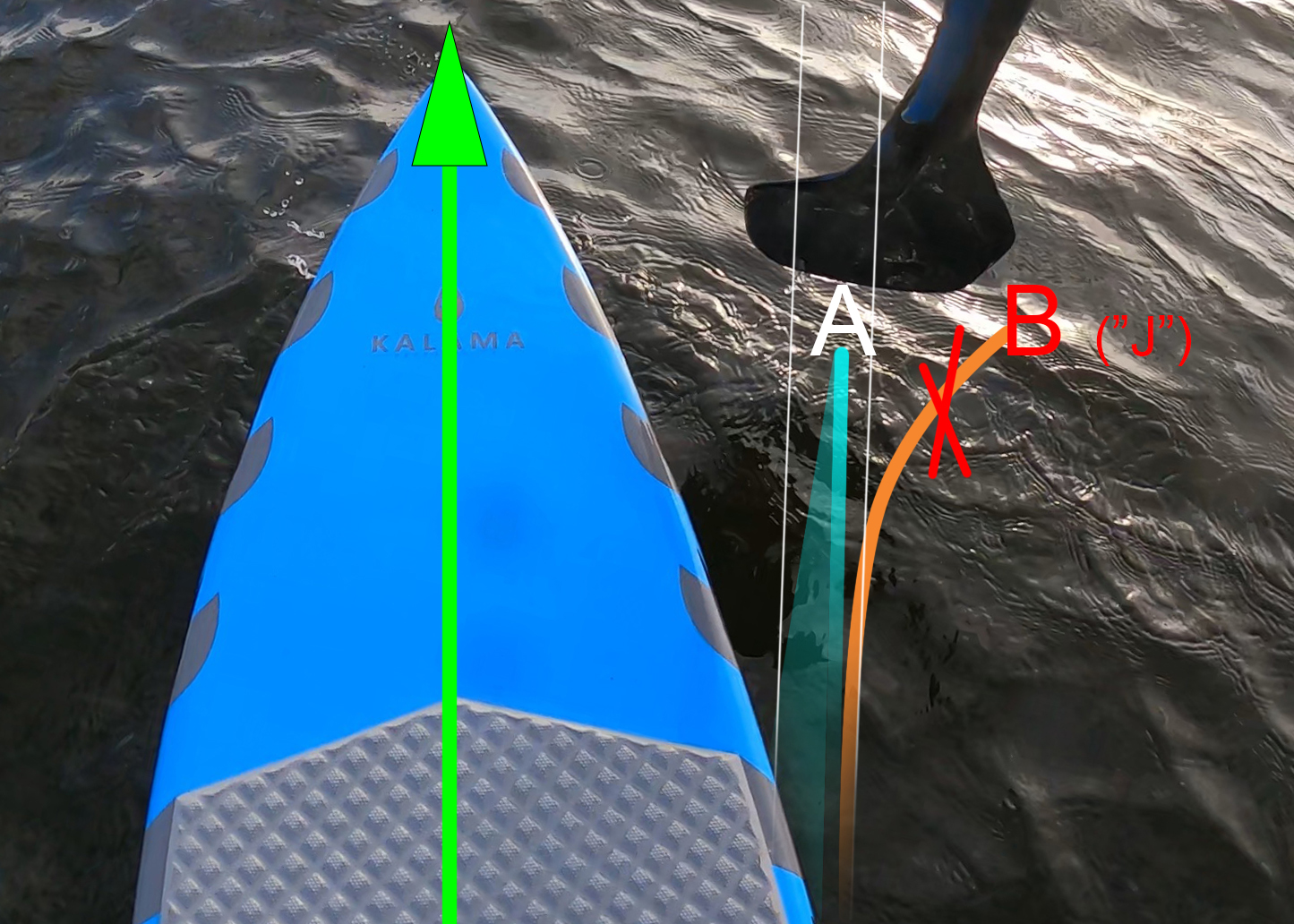
One half of the blade is deeper and reaches the surface of the water earlier, which further helps to create a favorable angle of the blade for the actual drive phase. This with a maintained stability and power development. The outline with a “cut out” on the side of the paddle blade that meets the board, allows us to have a higher blade on the outer side (high aspect). Which creates a paddle with better stability and wider power range, compared to some extremely wide (low aspect) SUP-foiling paddles.
Short summary of the concept
On a SUP-foil it’s desirable to create a force with the paddle that both gives speed and lift, but also prevents the board from turning. This applies to most SUP disciplines, but becomes extra decisive on a foil-board.
The more the paddler can focus on proper forward power, and not counteracting the turning / yaw, the more efficient the “pop up sequence” will be.
A paddler with good technique has no problem solving this with a traditional symmetrical paddle. A specialized SUP-foil paddle will make it even easier and more enjoyable. (Our favorite is the Black Project Foil-X. It has a very powerful catch, easy to paddle at high cadence and is super versatile in all different foiling situations.)
However, an asymmetrical blade could be designed so that the equation of “pop ups” becomes even more efficient. Mainly depending on how the force from the blade is directed. And that force can be directed differently depending on how the profile and the outline of the blade is designed. That’s what this design study showed us. An asymmetrical concept can thus help to direct the power so that it counteract the undesirable yaw / turning tendency when doing “pop ups”.
The disadvantages of an asymmetrical blade lie mainly in the fact that producers need to offer two different blade types; right and left blades (based on paddler preference). Apart from this we see no major technical disadvantages or other obstacles for an asymmetric choice of design.
Finally; thanks to Ulrik Kursten (2ride Sweden) for the composite work, mockup and prototyping. Simply super quality.
More updates to come.
Pontus Ny / Boardsporter.se / Ståpaddla
ISA Open Water SUP instructor / ISA Flat Water SUP instructor
Product Designer / Industrial Designer MFA
Life Kinetik instructor
 PONTUS NY